Loading...
Searching...
No Matches
draw.h File Reference
#include <banjo/api.h>#include <banjo/bitmap.h>#include <banjo/error.h>#include <banjo/math.h>#include <banjo/pixel.h>#include <banjo/rect.h>Include dependency graph for draw.h:
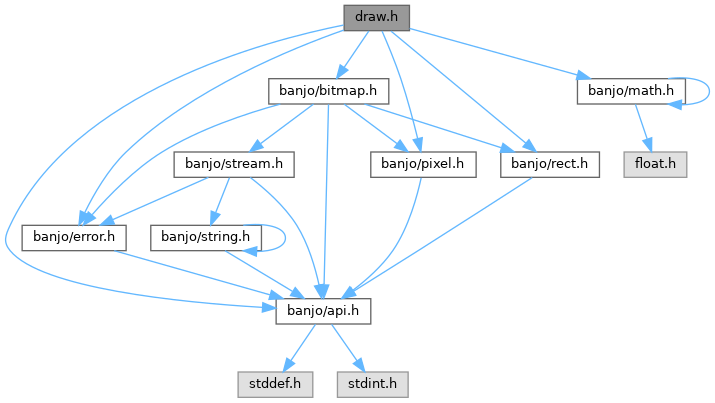
This graph shows which files directly or indirectly include this file:

Go to the source code of this file.
Macros | |
| #define | BJ_LINE_STEPPED BJ_LINE_MODE_STEPPED |
| #define | BJ_LINE_WATERTIGHT BJ_LINE_MODE_WATERTIGHT |
Enumerations | |
| enum | bj_line_mode { BJ_LINE_MODE_STEPPED = 0 , BJ_LINE_MODE_WATERTIGHT } |
| enum | bj_polyline_end { BJ_POLYLINE_END_OPEN = 0 , BJ_POLYLINE_END_CLOSED = 1 } |
Functions | |
| void | bj_draw_line (struct bj_bitmap *bitmap, int x0, int y0, int x1, int y1, uint32_t pixel) |
| void | bj_draw_line_mode (struct bj_bitmap *bitmap, int x0, int y0, int x1, int y1, bj_line_mode mode, uint32_t pixel) |
| void | bj_draw_rectangle (struct bj_bitmap *bitmap, const struct bj_rect *area, uint32_t pixel) |
| void | bj_draw_filled_rectangle (struct bj_bitmap *bitmap, const struct bj_rect *area, uint32_t pixel) |
| void | bj_draw_triangle (struct bj_bitmap *bitmap, int x0, int y0, int x1, int y1, int x2, int y2, uint32_t color) |
| void | bj_draw_filled_triangle (struct bj_bitmap *bitmap, int x0, int y0, int x1, int y1, int x2, int y2, uint32_t color) |
| void | bj_draw_circle (struct bj_bitmap *bitmap, int cx, int cy, int radius, uint32_t color) |
| void | bj_draw_filled_circle (struct bj_bitmap *bitmap, int cx, int cy, int radius, uint32_t color) |
| void | bj_draw_polyline (struct bj_bitmap *bitmap, size_t count, const int *x, const int *y, bj_polyline_end end, uint32_t color) |
| void | bj_draw_polyline_mode (struct bj_bitmap *bitmap, size_t count, const int *x, const int *y, bj_polyline_end end, bj_line_mode mode, uint32_t color) |
Pixel enumeration | |
The drawing functions above answer "paint this shape". The functions below answer a different question: "which pixels does this shape touch?" — and answer it without touching a bitmap at all. The same walk drives both: bj_draw_line and bj_enumerate_line_pixels visit exactly the same pixels, in the same order. Only the destination differs. This is what you want for edge walking in a software rasteriser, ray casting over a tile map, line-of-sight tests, or picking — anywhere the coordinates are the result and no pixel is ever written. | |
| typedef bj_bool(* | bj_pixel_fn) (void *user_data, int x, int y) |
| typedef bj_bool(* | bj_cell_fn) (void *user_data, int x, int y, bj_real t) |
| void | bj_enumerate_line_pixels (int x0, int y0, int x1, int y1, bj_pixel_fn callback, void *user_data) |
| void | bj_line_pixels (int x0, int y0, int x1, int y1, bj_pixel_fn callback, void *user_data) |
| void | bj_enumerate_circle_pixels (int cx, int cy, int radius, bj_pixel_fn callback, void *user_data) |
| void | bj_circle_pixels (int cx, int cy, int radius, bj_pixel_fn callback, void *user_data) |
| void | bj_enumerate_grid_ray_cells (bj_real x0, bj_real y0, bj_real x1, bj_real y1, bj_cell_fn callback, void *user_data) |
| void | bj_grid_ray_cells (bj_real x0, bj_real y0, bj_real x1, bj_real y1, bj_cell_fn callback, void *user_data) |