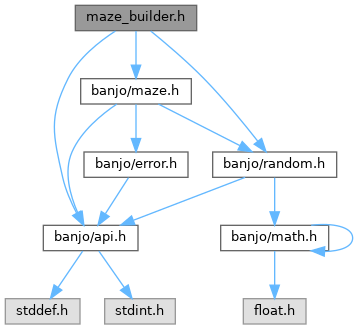
Go to the source code of this file.
Data Structures | |
| struct | bj_maze_build_context |
| struct | bj_maze_algorithm |
Typedefs | |
| typedef void *(* | bj_maze_setup_fn) (const struct bj_maze_build_context *context, struct bj_error **error) |
| typedef bj_bool(* | bj_maze_step_fn) (struct bj_maze_build_context *context) |
| typedef void(* | bj_maze_teardown_fn) (void *data) |
Enumerations | |
| enum | bj_maze_mark { BJ_MAZE_MARK_VISITED = 1u << 0 , BJ_MAZE_MARK_HEAD = 1u << 1 , BJ_MAZE_MARK_PATH = 1u << 2 , BJ_MAZE_MARK_USER = 1u << 3 } |
Detailed Description
Header file for Maze generation.
A builder carves passages into a maze made by maze.h, one step at a time. Nothing here decides what a maze looks like; it decides which walls come down.
One step at a time
Generation is driven by the caller rather than run to completion behind its back. bj_step_maze_builder does a single unit of work and returns, so a program can spread a generation over frames and draw the maze as it appears:
bj_run_maze_builder is the shortcut for a caller that only wants the finished maze and has no interest in watching it happen.
A step reports whether it did something, not whether it is finished, and the difference matters. A generation ends on a step that finds nothing left to do, which costs one extra call and buys the guarantee that a BJ_TRUE means the maze moved on and is worth drawing again. It also fails in the useful direction: an algorithm that loses track of itself stops early rather than spinning forever.
Which algorithm
An algorithm is a bj_maze_algorithm — a setup, a step and a teardown, handed over together. The built-in ones and your own are the same kind of thing, so anything the library can run, your code can supply.
None of them takes any settings. The two that name directions could be pointed at another corner, but every pair gives the same maze turned or mirrored, which is the business of whatever transforms a finished grid rather than of the algorithm that carved it.
Six come with the library:
| Algorithm | Family | Character |
|---|---|---|
| bj_maze_algorithm_btree | orthogonal | The cheapest, and the most lopsided |
| bj_maze_algorithm_sidewinder | orthogonal | Lopsided along one edge only |
| bj_maze_algorithm_aldous_broder | any | Even-handed, and slow about it |
| bj_maze_algorithm_wilson | any | Even-handed, usually quicker |
| bj_maze_algorithm_hunt_and_kill | any | Long winding corridors, quick, uneven |
| bj_maze_algorithm_backtracker | any | The longest, windingest corridors of all |
The two that name directions only make sense on a grid that has them. The four that ask for neighbours and nothing else work on any family there is, or ever will be.
Where the randomness comes from
Passing NULL for the RNG callback draws from the global engine seeded by bj_srand, which is convenient but not reproducible: two mazes from the same seed only match if nothing else drew from that engine in between. Pass bj_pcg32_generator with your own bj_pcg32 whenever the same seed must give the same maze.
Watching it work
Hand bj_create_maze_builder a set of bj_maze_marks and the algorithm records what it is doing as it goes: which cells it has reached, where it is standing, what it is still weighing up. A program can then colour a generation in progress without knowing which algorithm is running. Hand it NULL instead and nothing is recorded, nothing is allocated, and every algorithm still runs the same.
Definition in file maze_builder.h.