Data Structures | |
| struct | bj_cli_argument |
| struct | bj_cli |
Typedefs | |
| typedef bj_bool(* | bj_cli_action_fn) (const struct bj_cli *parser, const struct bj_cli_argument *arg, const char *value, void *dest, struct bj_error **error) |
Functions | |
| bj_bool | bj_parse_cli (struct bj_cli *parser, int argc, char *argv[], struct bj_error **error) |
| bj_bool | bj_validate_cli (const struct bj_cli *parser, struct bj_error **error) |
| void | bj_print_cli_help (const struct bj_cli *parser) |
| size_t | bj_get_cli_help_string (const struct bj_cli *parser, char *buffer, size_t buffer_size) |
| bj_bool | bj_store_cli_cstring (const struct bj_cli *parser, const struct bj_cli_argument *arg, const char *value, void *dest, struct bj_error **error) |
| bj_bool | bj_store_cli_double (const struct bj_cli *parser, const struct bj_cli_argument *arg, const char *value, void *dest, struct bj_error **error) |
| bj_bool | bj_store_cli_int (const struct bj_cli *parser, const struct bj_cli_argument *arg, const char *value, void *dest, struct bj_error **error) |
| bj_bool | bj_store_cli_uint (const struct bj_cli *parser, const struct bj_cli_argument *arg, const char *value, void *dest, struct bj_error **error) |
| bj_bool | bj_store_cli_bool (const struct bj_cli *parser, const struct bj_cli_argument *arg, const char *value, void *dest, struct bj_error **error) |
| bj_bool | bj_print_cli_help_action (const struct bj_cli *parser, const struct bj_cli_argument *arg, const char *value, void *dest, struct bj_error **error) |
Detailed Description
Parse argc/argv into named options and positional values.
Every C program that runs from a shell starts with int main(int argc, char* argv[]). Banjo's CLI subsystem helps you turn that pair into something useful: the user runs myprog --port 8080 -v input.txt, and you get a structured view (port = 8080, verbose = true, input file = "input.txt") without having to walk argv by hand or write a parser.
You describe your program's accepted arguments (one bj_cli_argument per option or positional), pass them and argc/argv to bj_parse_cli, and you're done. --help is generated for you from the descriptions.
What it understands
- Short options (one dash, one letter): -f, -v, -o.
- Long options (two dashes, a word): --file, --verbose, --output.
- Values attached to options: -finput.txt and -f input.txt both work; --file=input.txt and --file input.txt both work.
- Type conversion done for you: declare an option as int / unsigned / double / bool / string, and the parser converts the value and stores it where you tell it to.
- Flag options that don't take a value, just toggle a bool.
- Chained short options: -abc is -a -b -c, the GNU convention.
- Positional arguments: anything without a leading dash, either required or optional.
- Auto-generated --help: the parser prints a usage summary built from your argument descriptions.
Properties
- Zero heap allocation in the success path. The parser writes parsed values straight into the storage locations you pointed it at; nothing is malloc'd.
- Small implementation: it's a finite-state machine, small enough to embed in tools where binary size matters.
Data Structure Documentation
◆ bj_cli_argument
| struct bj_cli_argument |
Descriptor for a single command line argument.
Defines how an argument is parsed and stored by bj_parse_cli.
Most arguments will set .dest and either .name (long option) or .shortname (short option).
- Named arguments
Named arguments have .name (e.g., --file) or .shortname (e.g., -f). They can appear anywhere in the command line, multiple times, and are optional unless .required is set.
If the argument expects a value, .action and .dest must be set. The .action callback validates, converts, and stores the value.
- Flags
Flags are named arguments with no value expected. To create a flag, set .dest but leave .action as 0.
The integer pointed by .dest is set to 1 when the flag is present.
- Positional arguments
Positional arguments have no .name or .shortname. They are identified by their order relative to other positional arguments.
They can be declared anywhere in the argument list, mixed with named args.
Example:
- Examples
- banjo-info.c, and cli.c.
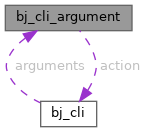
| Data Fields | ||
|---|---|---|
| bj_cli_action_fn | action |
Callback to parse/store argument value. If 0, .dest is set as int flag. |
| void * | dest |
Pointer to store parsed value. If 0, program exits after argument is found (e.g., --help). |
| const char * | help |
Help message shown in usage output. Can be 0 if no help needed. |
| const char * | metavar |
Placeholder for argument value in help output. Must not be 0 for flag arguments. |
| const char * | name |
Long option name (e.g., "file" for --file). Can be 0 if positional or only shortname used. |
| int | required | Set to 1 if positional argument is mandatory. |
| char | shortname |
Short option name (e.g., 'o' for -o). Can be 0 if positional or only long name used. |
◆ bj_cli
| struct bj_cli |
Parser context and argument list descriptor.
Contains global parser settings, program info, and list of argument descriptors.
- Examples
- banjo-info.c, and cli.c.
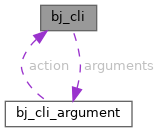
| Data Fields | ||
|---|---|---|
| struct bj_cli_argument * | arguments | Pointer to array of argument descriptors. |
| size_t | arguments_len | Number of arguments in the parser. |
| const char * | description | Description text displayed before argument list. |
| const char * | epilog | Text displayed after argument list. |
| const char * | prog | Program name; if 0, argv[0] is used. |
Typedef Documentation
◆ bj_cli_action_fn
| typedef bj_bool(* bj_cli_action_fn) (const struct bj_cli *parser, const struct bj_cli_argument *arg, const char *value, void *dest, struct bj_error **error) |
Callback function prototype for argument value processing.
Set in each bj_cli_argument to parse, validate and store the argument's string value extracted from argv.
Predefined callbacks include:
- bj_store_cli_cstring
- bj_store_cli_double
- bj_store_cli_int
- bj_store_cli_uint
- bj_store_cli_bool
- bj_print_cli_help_action
- Parameters
-
parser Pointer to the bj_cli instance arg Pointer to the argument descriptor value Argument string value from argv dest Pointer to storage location error Error output location (may be NULL to ignore errors)
- Returns
- BJ_TRUE on success, BJ_FALSE on error
Function Documentation
◆ bj_get_cli_help_string()
| size_t bj_get_cli_help_string | ( | const struct bj_cli * | parser, |
| char * | buffer, | ||
| size_t | buffer_size ) |
Get help message as a string for custom output.
Generates formatted help text into the provided buffer.
This function can be called with buffer set to NULL and buffer_size set to 0, in which case it returns the required buffer size without writing anything.
- Parameters
-
parser Pointer to the argument parser configuration. buffer Buffer to write help text to (may be NULL). buffer_size Size of buffer in bytes.
- Returns
- Number of bytes written (excluding null terminator), or required size if buffer is NULL.
- See also
- bj_print_cli_help
◆ bj_parse_cli()
Parse command-line arguments according to parser configuration.
Parses the provided argument vector (argv) according to the argument descriptors in parser, storing results in the destinations specified by each argument.
This function validates the parser configuration, processes all arguments, and reports any errors through the error system.
- Parameters
-
parser Pointer to the argument parser configuration. argc Argument count (typically from main). argv Argument vector (typically from main). error Error output location (may be NULL to ignore errors).
- Returns
- BJ_TRUE on success, BJ_FALSE if parsing failed or configuration invalid.
- Error Codes
- BJ_ERROR_INVALID_DATA: Parser configuration error (duplicate names, etc.)
- BJ_ERROR_INCORRECT_VALUE: Invalid argument value provided
- BJ_ERROR: General parsing error (missing required args, unknown options, etc.)
- Zero-Heap Design
- This function does not allocate heap memory during normal operation. Memory allocation only occurs if an error is reported (for error object).
- See also
- bj_validate_cli, bj_print_cli_help
- Examples
- banjo-info.c, and cli.c.
Referenced by main().
◆ bj_print_cli_help()
| void bj_print_cli_help | ( | const struct bj_cli * | parser | ) |
Print help message using Banjo's logging system.
Generates and prints formatted help text showing program description, usage syntax, and all argument descriptions using bj_info().
- Parameters
-
parser Pointer to the argument parser configuration.
- See also
- bj_get_cli_help_string
- Examples
- banjo-info.c, and cli.c.
Referenced by main().
◆ bj_print_cli_help_action()
| bj_bool bj_print_cli_help_action | ( | const struct bj_cli * | parser, |
| const struct bj_cli_argument * | arg, | ||
| const char * | value, | ||
| void * | dest, | ||
| struct bj_error ** | error ) |
Print help argument action.
Special action function to trigger printing help and exiting. Use this as the .action for a --help argument.
- Parameters
-
parser Parser instance. arg Argument descriptor. value Argument string (usually NULL). dest Destination (if 0, program exits after printing help). error Error output location.
- Returns
- BJ_TRUE always.
- Examples
- banjo-info.c, and cli.c.
Referenced by main().
◆ bj_store_cli_bool()
| bj_bool bj_store_cli_bool | ( | const struct bj_cli * | parser, |
| const struct bj_cli_argument * | arg, | ||
| const char * | value, | ||
| void * | dest, | ||
| struct bj_error ** | error ) |
Store boolean argument value.
Accepts true, false, 1, 0, yes, no (case-insensitive).
- Parameters
-
parser Parser instance. arg Argument descriptor. value String representation of bool value. dest Destination pointer (int*). error Error output location.
- Returns
- BJ_TRUE on success, BJ_FALSE on error.
- Error Codes
- BJ_ERROR_INCORRECT_VALUE: Invalid boolean value
- Examples
- cli.c.
Referenced by main().
◆ bj_store_cli_cstring()
| bj_bool bj_store_cli_cstring | ( | const struct bj_cli * | parser, |
| const struct bj_cli_argument * | arg, | ||
| const char * | value, | ||
| void * | dest, | ||
| struct bj_error ** | error ) |
Store string argument value.
Stores value as a null-terminated string pointer. The pointer is stored directly (no copy is made).
- Parameters
-
parser Parser instance. arg Argument descriptor. value C-string value. dest Destination pointer (const char**). error Error output location.
- Returns
- BJ_TRUE on success, BJ_FALSE on error.
- Examples
- cli.c.
Referenced by main().
◆ bj_store_cli_double()
| bj_bool bj_store_cli_double | ( | const struct bj_cli * | parser, |
| const struct bj_cli_argument * | arg, | ||
| const char * | value, | ||
| void * | dest, | ||
| struct bj_error ** | error ) |
Store double argument value.
Parses and stores a double floating point value.
- Parameters
-
parser Parser instance. arg Argument descriptor. value String representation of float value. dest Destination pointer (double*). error Error output location.
- Returns
- BJ_TRUE on success, BJ_FALSE on error.
- Error Codes
- BJ_ERROR_INCORRECT_VALUE: Invalid or out-of-range value
- Examples
- cli.c.
Referenced by main().
◆ bj_store_cli_int()
| bj_bool bj_store_cli_int | ( | const struct bj_cli * | parser, |
| const struct bj_cli_argument * | arg, | ||
| const char * | value, | ||
| void * | dest, | ||
| struct bj_error ** | error ) |
Store int argument value.
Parses and stores a signed integer value.
- Parameters
-
parser Parser instance. arg Argument descriptor. value String representation of int value. dest Destination pointer (int*). error Error output location.
- Returns
- BJ_TRUE on success, BJ_FALSE on error.
- Error Codes
- BJ_ERROR_INCORRECT_VALUE: Invalid or out-of-range value
- Examples
- cli.c.
Referenced by main().
◆ bj_store_cli_uint()
| bj_bool bj_store_cli_uint | ( | const struct bj_cli * | parser, |
| const struct bj_cli_argument * | arg, | ||
| const char * | value, | ||
| void * | dest, | ||
| struct bj_error ** | error ) |
Store unsigned int argument value.
Parses and stores an unsigned integer value.
- Parameters
-
parser Parser instance. arg Argument descriptor. value String representation of unsigned int value. dest Destination pointer (unsigned int*). error Error output location.
- Returns
- BJ_TRUE on success, BJ_FALSE on error.
- Error Codes
- BJ_ERROR_INCORRECT_VALUE: Invalid or out-of-range value
◆ bj_validate_cli()
Check for configuration errors in the parser.
Ensures no conflicts or inconsistencies in argument definitions. Reports configuration errors such as:
- Duplicate argument names or shortnames
- Invalid characters in names
- Conflicting dest pointers
- Invalid metavar usage
- Parameters
-
parser Pointer to the argument parser configuration. error Error output location (may be NULL to ignore errors).
- Returns
- BJ_TRUE if configuration is valid, BJ_FALSE if errors found.
- Error Codes
- BJ_ERROR_INVALID_DATA: Parser configuration has errors